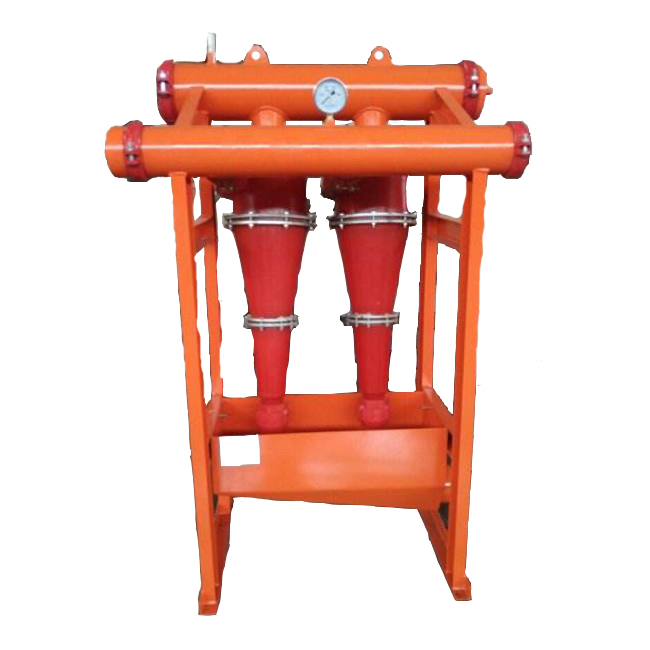
A hydrocyclone desander is a vital piece of equipment in a drilling fluid solids control system, it used to remove abrasive sand and larger particles from the drilling mud.By using centrifugal force to separate solids from the liquid, the desander protect
Targeted Solid Control Solution for Drilling Operations
The hydrocyclone desander is engineered as a critical component within drilling fluid solid control systems, designed primarily for oil and gas companies and drilling contractors who demand precise removal of abrasive solids. By focusing on particles typically ranging between 45 and 74 microns, this hydrocyclone separator safeguards downstream equipment such as pumps and shale shakers from accelerated wear. Its application as a secondary separation stage complements primary devices, thereby enhancing overall system reliability and drilling fluid maintenance. Hydrocyclone manufacturers tailor these separators to meet varying project scales, ensuring effective solids control for diverse drilling environments.
Advanced Design Features and Technical Specifications
Utilizing centrifugal force generated within its cone-shaped chambers, the hydrocyclone provides efficient segregation of solid contaminants from drilling fluids without the need for moving parts. Constructed from durable, wear-resistant polyurethane, the hydrocyclone sand separator offers extended operational life under abrasive conditions. Technical parameters include multiple models with treating capacities up to 240 m³/h, cone sizes of 8", 10", and 12", and feed inlet dimensions ranging from 125mm to 150mm. Optional integration with bottom shaker screens enhances fluid recovery, making the system adaptable to rigorous drilling applications requiring consistent particle size separation and high throughput.
Industry Integration and Operational Importance
Widely adopted in oilfield drilling and other mineral extraction industries, this hydrocyclone separator plays a vital role in maintaining drilling fluid cleanliness and stability. Its implementation aids in reducing drilling costs by minimizing equipment wear and preventing downtime associated with clogging or failure. Additionally, the hydrocyclone sand separator contributes to environmental compliance by controlling discharge solids and supporting fluid recycling systems alongside shale shakers and desilters. Through seamless integration into multi-stage solids control workflows, it enables continuous drilling performance optimization and resource conservation.
Product Advantages
Structural and Design Strengths
The hydrocyclone desander’s structural design incorporates multiple cone chambers arranged modularly to scale treating capacity while maintaining separation efficiency. Manufactured with wear-resistant polyurethane, it resists erosion caused by abrasive sands, ensuring long-term durability. The system’s simple mechanical configuration, void of moving parts, minimizes maintenance requirements while enabling rapid installation and integration within existing solids control frameworks. Hydrocyclone manufacturers emphasize compatibility with various flow rates and pressure conditions, allowing customization to specific drilling parameters and facilitating streamlined operational deployment.
Performance Efficiency and User Benefits
Performance-wise, the hydrocyclone separator achieves precise separation of fine solids through optimized centrifugal dynamics, enhancing drilling fluid quality and protecting valuable pumps and downstream equipment. Its adaptability to handling variable feed pressures and viscosities provides operational flexibility across drilling scenarios. Users benefit from reduced operational costs due to extended equipment life and improved fluid recycling rates afforded by optional shaker screen attachments. Furthermore, ease of maintenance and robust construction translate to higher uptime and lower total cost of ownership in harsh drilling environments where reliability is paramount.
A hydrocyclone desander is a vital piece of equipment in a drilling fluid solids control system, it used to remove abrasive sand and larger particles from the drilling mud.By using centrifugal force to separate solids from the liquid, the desander protects downstream drilling equipment from excessive wear, reduces drilling costs, and maintains the optimal properties of the drilling fluid.
How a hydrocyclone desander works
The desander is the second phase of a drilling solids control system and works in conjunction with other equipment like shale shakers and desilters.
Fluid entry: Drilling fluid is pumped from the mud tank into the desander's manifold and then into a bank of cone-shaped hydrocyclones.
Vortex action: The fluid enters the hydrocyclones tangentially under pressure, causing it to spin rapidly and create a vortex.
Separation: Centrifugal force pushes the denser, larger solid particles toward the outer wall of the cone. These solids spiral downwards toward the bottom of the cone.
Discharge: The separated solids exit through the bottom opening (apex) as the underflow.
Overflow: The lighter, cleaned drilling fluid moves in an upward spiral through the center of the cone and exits through the top opening (vortex finder) as the overflow.
Optional drying: In some units, the underflow solids are discharged onto a vibrating shaker screen, which provides further drying to recover more drilling fluid.
Number and size of cones: The quantity and diameter of the hydrocyclone cones determine the unit's capacity and particle separation efficiency. Common sizes for desander cones are 8, 10, and 12 inches.
Particle size removal (cut point): Desanders are typically designed to separate medium-sized solid particles, with a common separation range between 45 and 74 microns.
Material: The cones are often made from wear-resistant materials like polyurethane to withstand the abrasive nature of drilling fluids and ensure a longer lifespan.
Configuration: Some desanders are mounted over a shale shaker to maximize fluid recovery from the solids, while others are standalone units.
Specifications to consider
Parameters
Model
CSQ200
CSQ250
CSQ300
CSQ250W
Treating capacity
≤120m3/h ≤528GPM
≤180m3/h ≤792GPM
≤240m3/h ≤1056GPM
≤180m3/h ≤792GPM
Desander cones
8"
10"
12"
10"
Cones quantity
1~3EA
1~3EA
1~3EA
1~3 EA
Working pressure
0.15~0.35Mpa
Feed inlet
125mm
150mm
150mm
150mm
Discharge output
150mm
200mm
200mm
200mm
Separation size
47~76μm
Bottom shaker screen
1.0m2(600×1600mm) Optional
Without shaker
Use Scenarios
Oil and Gas Drilling Operations In conventional and directional drilling rigs, the hydrocyclone sand separator functions as a critical second-stage solids control device, positioned downstream of shale shakers. It effectively removes coarse particles that pose a risk of mechanical abrasion to pumps and motors, thereby preserving system integrity. The use of centrifugal force within the hydrocyclone separator ensures effective particle removal in compliance with operational standards for particle size distribution. Integration with existing solids control equipment streamlines workflows, facilitating continuous circulation of clean drilling fluids and reducing non-productive time related to equipment failures or fluid contamination.
Mineral Extraction and Environmental Management
During mineral drilling and exploration, the hydrocyclone desander serves to separate heavy sand particles from circulating fluids, optimizing resource extraction efficiency. Its capacity to process large volumes combined with wear-resistant materials ensures reliable operation in abrasive conditions typical of mining sites. The unit supports environmental compliance by minimizing solid discharge into disposal systems and enhancing fluid recovery rates. When integrated into multi-stage solids control setups alongside desilters and drying screens, it contributes to a closed-loop drilling fluid management process that maximizes operational sustainability and regulatory adherence.
FAQ
What particle size range can your hydrocyclone desander separate?
We design our hydrocyclone desanders to effectively separate solid particles ranging from 45 to 74 microns, ensuring precise removal of abrasive sand and large solids to protect downstream equipment and maintain drilling fluid quality.
Can I customize the hydrocyclone separator for specific drilling needs?
Yes, our hydrocyclone separators come in multiple cone sizes (8", 10", 12") and can be configured with 1 to 3 cones per unit. We work with you to select the right model and capacity to meet site-specific operational requirements.
Does the hydrocyclone desander require special installation or maintenance?
Our hydrocyclones are designed for straightforward integration within existing solids control systems. Routine inspection of wear-resistant polyurethane cones and optional shaker screens ensures longevity and consistent performance.
Is it possible to integrate the hydrocyclone sand separator with other solids control equipment?
Certainly. Our hydrocyclone sand separators function as a second-stage separation device and are compatible with shale shakers and desilters to enhance multi-stage solids control, improving drilling fluid recycling and equipment protection.





 +86 1871 286 0976

 sales@jxsolidscontrol.com